17 AUGUST 2026



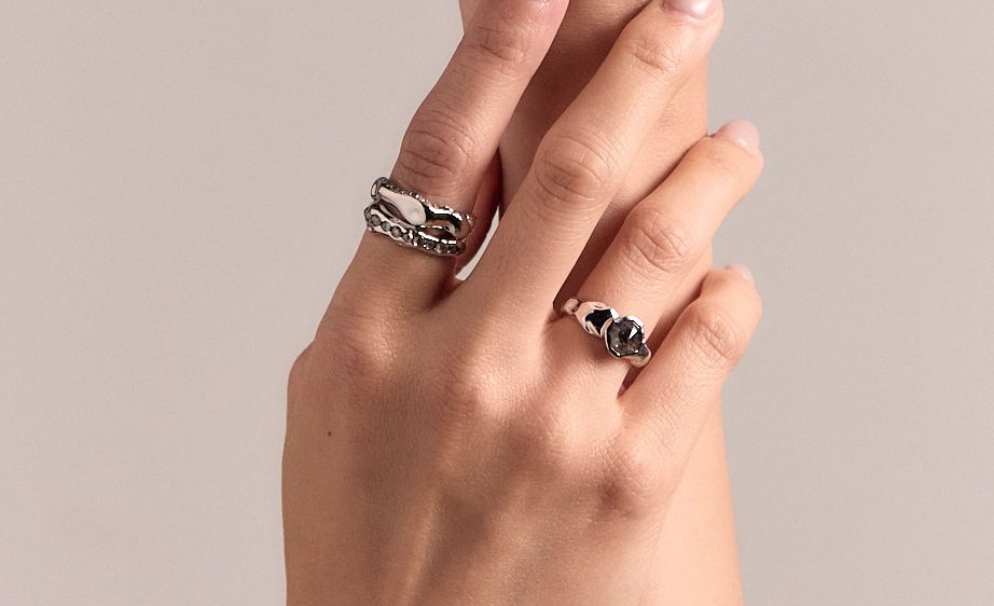
Traditionally, diamonds have often been appreciated through qualities such as clarity, brilliance and rarity. Salt-and-pepper diamonds invite us to appreciate something else too: character, individuality and the beauty found in their natural inclusions.
No two are quite alike. Their inclusions may appear as scattered specks, clouds, feathers or distinctive patterns within the stone. Some are light and translucent, others smoky or dark.
At Twomorrow Jewellery, that individuality is what first drew us to these stones. It also sits at the heart of what we believe: there can be more than one way to see beauty.
For someone looking for a salt and pepper diamond ring or an alternative engagement ring, the choice can become deeply personal. Alongside the familiar considerations of cut, colour, clarity and carat, there can be another question worth asking:
Which diamond speaks to you?
What Exactly Is a Salt-and-Pepper Diamond?
A salt-and-pepper diamond is a natural diamond with visible inclusions that form part of the stone’s appearance and character.
Inclusions are internal characteristics that form within a diamond. They can take different forms, including crystals, pinpoints, clouds and feathers.
In salt-and-pepper diamonds, these characteristics can create patterns that appear speckled, smoky, cloudy, icy or almost opaque. Some stones may have a scattering of visible inclusions, while others have much more pronounced patterns.
There is no single appearance that defines a beautiful salt-and-pepper diamond.
For us, this is part of their appeal.
Because the nature, position and combination of inclusions differ from diamond to diamond, each stone has its own identity. It is an unconventional diamond precisely because the characteristics that make it different are allowed to be seen.
Understanding Clarity Differently
In conventional diamond grading, clarity measures the relative absence of inclusions and blemishes.
The GIA clarity scale contains 11 grades, ranging from Flawless (FL) through to Included (I1, I2 and I3). When determining a clarity grade, characteristics including the nature, size, number, position and visibility of inclusions are considered.
This remains an important framework for understanding diamonds.
Salt-and-pepper diamonds simply give us another way to look at some of those characteristics.
Instead of automatically seeking the diamond with the fewest visible inclusions, someone choosing a salt-and-pepper diamond may find themselves drawn to the way its inclusions create depth, contrast or an unusual pattern.
It does not mean grading no longer matters. It means a grade alone may not explain why you connect with a particular stone.
At Twomorrow, we look at the diamond as a whole: its appearance and character, alongside the nature and position of its inclusions, its durability and its suitability for jewellery.
Why Choose a Salt-and-Pepper Diamond?
Sometimes the answer is very simple: you see one and realise you have never seen another diamond quite like it.
For people looking for an alternative engagement ring, that individuality can feel especially meaningful.
Our founder’s first encounter with a salt-and-pepper diamond sparked a question that would eventually become part of Twomorrow’s story:
Who decided this was imperfect?
The question was never about saying that one kind of diamond is more beautiful than another. It was about wondering why beauty needed to have only one definition.
That idea continues to shape how we approach jewellery today.
A traditional white diamond can be beautiful. So can a diamond filled with visible inclusions. One does not have to take away from the other.
There is simply room for more than one idea of beauty.
No Two Salt-and-Pepper Diamonds Look the Same
One of the most distinctive qualities of salt-and-pepper diamonds is their individuality.
One may be translucent with fine black speckles. Another might appear smoky, cloudy or darker. Inclusions may gather in one part of the diamond or create a pattern across the stone.
Even two diamonds of the same shape and similar carat weight can look completely different when placed beside each other.
This changes the experience of choosing one.
Specifications can give you useful information about a diamond, but they may not tell you which one you will be drawn to.
At our atelier, we encourage clients to spend time looking at different stones and noticing what catches their attention.
Sometimes it is difficult to explain why one feels right.
You simply keep coming back to it.
Salt-and-Pepper and Traditional White Diamonds
Traditional white diamonds and salt-and-pepper diamonds can be appreciated for different qualities.
With a traditional white diamond, brilliance, colour and clarity often play an important role in selection. With a salt-and-pepper diamond, visible inclusions can become part of what draws someone to the stone.
Neither approach is more meaningful than the other.
It comes down to what you personally value and connect with.
This is also why we don’t see salt-and-pepper diamonds simply as more affordable substitutes for traditional white diamonds. While their pricing can sometimes be more accessible, prices vary considerably according to the individual stone’s size, cut, appearance and other characteristics.
For us, the reason to choose a salt-and-pepper diamond is because you genuinely love the diamond in front of you.
Designing with Salt-and-Pepper Diamonds
Because each salt-and-pepper diamond has its own pattern, shape and proportions, we often allow the stone to influence the design around it.
A setting can be restrained so the diamond remains the focus, or the stone can become part of a more expressive design involving texture, asymmetry, unusual forms or contrasting metals.
There is no fixed formula.
Beyond engagement diamond rings, salt-and-pepper diamonds can also be used in earrings, necklaces and other forms of fine jewellery in Singapore.
This is one of the things we enjoy about working with an unconventional diamond. Rather than treating every stone as interchangeable, we can consider the individual characteristics of the diamond when deciding how the finished piece should come together.
From Stone to Setting: Choosing Yours at Our Telok Ayer Atelier
Photographs are useful, but salt-and-pepper diamonds can look very different once you see them in person.
At our appointment-only atelier in a conserved shophouse in Telok Ayer, clients can view and compare different stones and see how their patterns, translucency and appearance change as they move through the light.
Some people arrive with a very clear idea of what they want. Others find themselves unexpectedly drawn to a stone they might never have chosen from a photograph.
Once you find your diamond, we can explore how you would like to make it yours, whether through a Twomorrow Signature design or a fully bespoke piece created around the stone.
If you are considering a bespoke engagement ring in Singapore, our step-by-step guide explains the process from consultation and diamond selection through to design and crafting.
Caring for a Salt-and-Pepper Diamond
Salt-and-pepper diamonds are loved for their inclusions, but not all inclusions are the same.
Some contribute primarily to a diamond’s appearance, while others may affect its structural integrity depending on their nature, size and position.
This is why every salt-and-pepper diamond at Twomorrow is individually hand-selected and evaluated before we choose to work with it.
Drawing from GIA diamond training and years of experience working closely with unconventional diamonds, we look beyond appearance to understand the nature and position of its inclusions.
We choose stones that meet our standards for both character and durability. While we celebrate the inclusions that make each diamond different, we are equally mindful that fine jewellery is made to be worn and enjoyed.
As with any fine jewellery, we recommend wearing your piece with care. Avoid vigorous activities or situations where the diamond may be subjected to strong impact, and have your jewellery professionally checked and serviced periodically.
Sourcing and Certification Matter
Sourcing and certification are important considerations when choosing a diamond.
At Twomorrow Jewellery, every stone is carefully assessed for quality and durability, professionally certified by GIA or trusted gemological laboratories where applicable, and sourced with care in compliance with the Kimberley Process.
Salt-and-pepper diamonds are a little different. Their inclusions are part of what gives each stone its character, so conventional grading systems do not always reflect what is valued in these diamonds.
While they are not typically accompanied by traditional grading reports, Twomorrow provides an authenticity certificate for our natural salt-and-pepper diamonds, giving clients assurance that the stone they have chosen is a natural diamond.
Why Seeing the Diamond in Person Matters
Choosing a salt-and-pepper diamond is a particularly visual and personal experience.
A photograph captures one view of the stone. In person, you can turn the diamond in your hand, see its translucency and notice how its appearance changes under different light.
This is why we give clients the opportunity to spend time with different stones rather than choosing solely from specifications.
It is less about deciding which diamond is technically “better” and more about discovering what you personally respond to.
For some, that will be a light, subtly included stone. For others, it may be something darker and more expressive.
There is no right answer.
Frequently Asked Questions
Are salt-and-pepper diamonds real diamonds?
Yes. Salt-and-pepper diamonds are natural diamonds. The term describes diamonds with visible inclusions that form part of their distinctive appearance.
Are salt-and-pepper diamonds more affordable than white diamonds?
They can sometimes be more accessible in price than traditional white diamonds of a comparable size, but pricing varies considerably between individual stones.
At Twomorrow, we don’t see them as substitutes for traditional diamonds. We believe the reason to choose one is because you connect with its individual character.
Do salt-and-pepper diamonds come with a certificate?
Salt-and-pepper diamonds are natural diamonds, but their inclusions are precisely what make them distinctive. Conventional clarity grading systems do not always reflect what is valued in these stones.
While they are not typically accompanied by traditional grading reports, Twomorrow provides an authenticity certificate for our natural salt-and-pepper diamonds, giving clients assurance that the stone they have chosen is a natural diamond.
Will the visible inclusions make the diamond weaker?
Not necessarily, but inclusions should not be considered purely cosmetic either.
Different inclusions can affect a diamond differently depending on their nature, size and position. Certain inclusions, particularly those that reach the surface or occur in more vulnerable areas, may affect structural integrity.
This is why careful selection matters. Every salt-and-pepper diamond we choose to work with is individually evaluated with both character and durability in mind.
Can I use a salt-and-pepper diamond for an engagement ring?
Yes. A salt and pepper diamond ring can be a beautiful choice for someone drawn to visible character and individuality.
As with any engagement ring, we consider the individual diamond, setting and how the piece will be worn when developing the design.
Can I see salt-and-pepper diamonds in person in Singapore?
Yes. Our Telok Ayer atelier is open by appointment, where you can view and compare our curated selection of natural salt-and-pepper diamonds before deciding on your stone and setting.
Find the One That Speaks to You
Perhaps the beauty of a salt-and-pepper diamond is that there isn’t one version of what it should look like.
Some are light and translucent. Some are darker and more expressive. Some reveal their inclusions immediately, while others make you look a little closer.
If you are looking for an alternative engagement ring, an unconventional diamond, or simply something that feels more like you, explore our diamond rings online or book a private appointment at our Telok Ayer atelier to see the stones in person.
Because choosing differently doesn’t mean one choice is better than another.
Sometimes, it simply means finding what feels right for you.
